
What the new study compared
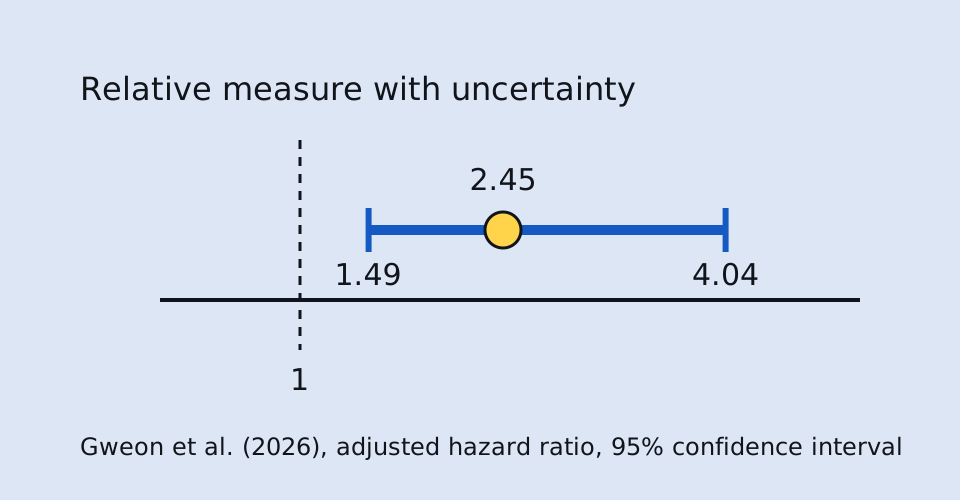
Gweon and colleagues analysed two US cohorts with a total of 112,284 participants and 278 documented cases of stomach cancer. For the highest sugar-sweetened beverage group compared with the reference group, they report a multivariable hazard ratio of 2.45, with a 95% confidence interval of 1.49 to 4.04. Artificially sweetened drinks showed no association with stomach cancer in the same analysis.
The group labels deserve attention: the table describes the highest group as more than one serving a day, while the results text says at least one serving. The reference group is labelled “never” in the table; the methods define it as less than one serving a month. These labels do not establish an apparently exact everyday threshold for individuals.
Original sources: Gweon TG et al. (2026)
What the finding supports: This is an observational analysis. Remaining differences between the groups may matter despite statistical adjustment. The authors note limitations including restricted information on Helicobacter pylori and tumour location.
Why 2.45 does not mean a 245% probability of disease
A hazard ratio compares the modelled event rate over time. It is neither the proportion of people who become ill nor a direct measure of personal risk over a fixed number of years. Those questions also require baseline risks, a time period, and the appropriate population.
Raw case counts per person-year and an adjusted hazard ratio must not be equated either. We therefore do not provide a calculation that might appear to estimate someone’s personal risk.
Original sources: Gweon TG et al. (2026)
What the finding supports: This page explains study measures. We do not derive individual medical recommendations from these data.
How earlier summaries fit into the picture
In their 2023 dose–response analysis for stomach cancer, Pan and colleagues found a relative estimate of 1.00 per additional 250 millilitres a day, with a 95% confidence interval of 0.85 to 1.17. The certainty of evidence was rated very low; this estimate does not prove the absence of an effect.
In another summary published in 2021, Li and colleagues reported a pooled estimate of 0.99 for the highest versus the lowest intake category, with a confidence interval of 0.79 to 1.29. A new positive finding and older inconclusive findings cannot be resolved by majority vote: definitions, populations, study types, and overlaps must be compared.
The additional 2026 analysis by Jayedi and colleagues is listed in our register as a preprint. It is explicitly labelled as not peer-reviewed and does not automatically receive the weight of a published final version.
Original sources: Pan B et al. (2023), Li Y et al. (2021), Jayedi A et al. (2026)
What the finding supports: The reviews by Pan and Li partly draw on the same cohorts for stomach cancer, so they are not independent of each other. Their measures also do not all refer to the same consumption comparison as the new US analysis.