
Muscle cells can drive a structure
In a 2014 study, Cvetkovic and colleagues combined a soft, printed frame with a strip of skeletal muscle tissue. Electrical pulses triggered contractions. Because the structure was asymmetric, the shortening produced directed movement.
In a 2016 study from the same research setting, Raman and colleagues developed light-sensitive muscle constructs. Here, pulses of blue light triggered contraction. The change concerned the method of stimulation: it did not turn the muscle strip into an animal capable of making its own decisions.
Original sources: Cvetkovic et al. 2014, Raman et al. 2016
What the finding supports: These systems need a supply of nutrients and controlled conditions. Two studies from the same research setting are not two independent replications.
How cells are arranged makes a difference
For the xenobots developed by Kriegman and colleagues, possible body shapes were first explored on a computer. The researchers then assembled selected structures from embryonic frog cells. In the reported setup, skin and heart muscle cells could together form a moving group.
The interesting point is the relationship between material and shape. Cells provide particular properties; their spatial arrangement influences the resulting movement. Computer simulation and the constructed experiment remain two distinct steps.
Original sources: Kriegman et al. 2020
What the finding supports: The experiment demonstrates an engineered living system in the laboratory. It establishes neither an arbitrary capability of all cells nor a medical robot ready for use.
Human cells can form moving groups
Gumuskaya and colleagues cultured human airway cells into small groups whose cilia enabled movement. This self-organisation took place under deliberately established culture conditions; the researchers determined factors including the environment and the preparation of the cells.
In a further experiment, several groups were placed across a gap in a neuronal culture. The paper reports bridging of this gap under certain conditions. A cell culture with an artificial gap is, however, a different situation from an injury in a person.
Original sources: Gumuskaya et al. 2023/24
What the finding supports: The paper reports a laboratory finding. We do not infer demonstrated wound healing or treatment in humans. Xenobot and anthrobot studies also share part of their research setting.
How neurons were connected to Pong
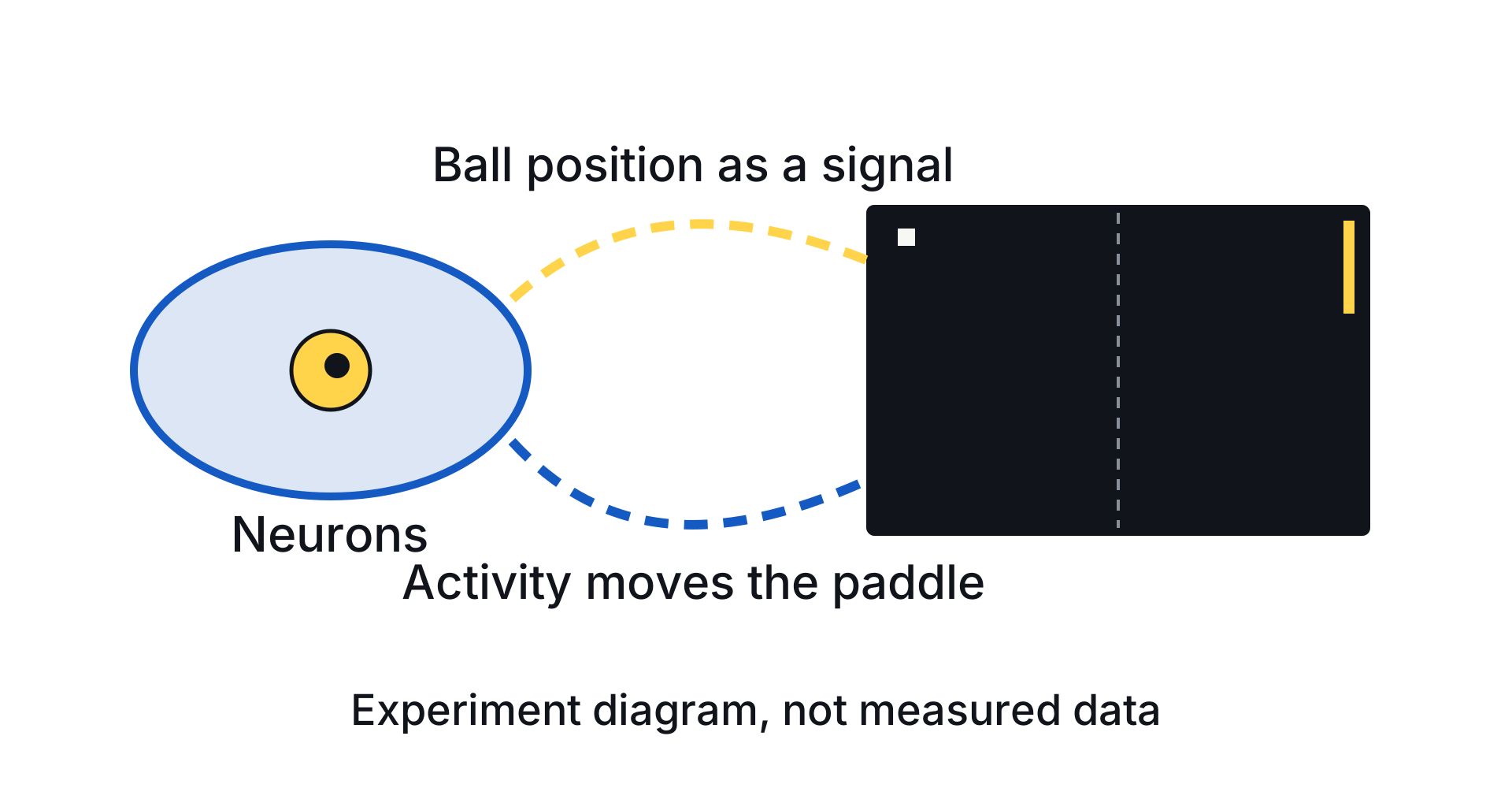
In the DishBrain experiment by Kagan and colleagues, neurons were placed on an array of electrodes. The position of a simulated ball was translated into electrical stimulation. Measured cell activity was then used to move the paddle in the simulation.
This created feedback between the cell culture and its technical environment. The authors report improvements in performance measures within game sessions and describe this as learning. The cells did not see a screen: the experimental setup defined the inputs and outputs.
Original sources: Kagan et al. 2022
What the finding supports: The reported change relates to this particular task and its evaluation method. It does not demonstrate general intelligence or answer whether the cell culture experiences anything.
Why consciousness is a separate question
The title of the DishBrain paper also uses the term “sentience”. The authors use it in a formal sense: being “responsive to sensory impressions” through adaptive internal processes. Balci and other authors criticised the use of such terms and the far-reaching claims drawn from them. The text we read is the submitted manuscript version of their scholarly commentary deposited with HAL.
We therefore distinguish the observed setup, the measured performance, and the interpretation. The commentary is a scholarly critique, not a new counter-experiment. Nor do we claim to present the complete debate with all responses.
Original sources: Kagan et al. 2022, Balci et al. 2023
What the finding supports: Our conclusion is narrower than a claim about consciousness: groups of cells can perform functions under certain conditions. Which terms appropriately describe their capabilities requires separate justification.